%20(1).png?width=1200&height=627&name=Arrived%20early.%20(6)%20(1).png)
.png?width=2048&height=1076&name=Design%20sans%20titre%20(8).png)

A ship burning fuel at full speed to arrive at a berth that isn't free. Another idling at anchor for eleven hours, waiting for a tide it beat by half a day. "Getting there" and "getting there right" are not the same thing - and what counts as right depends entirely on the voyage.
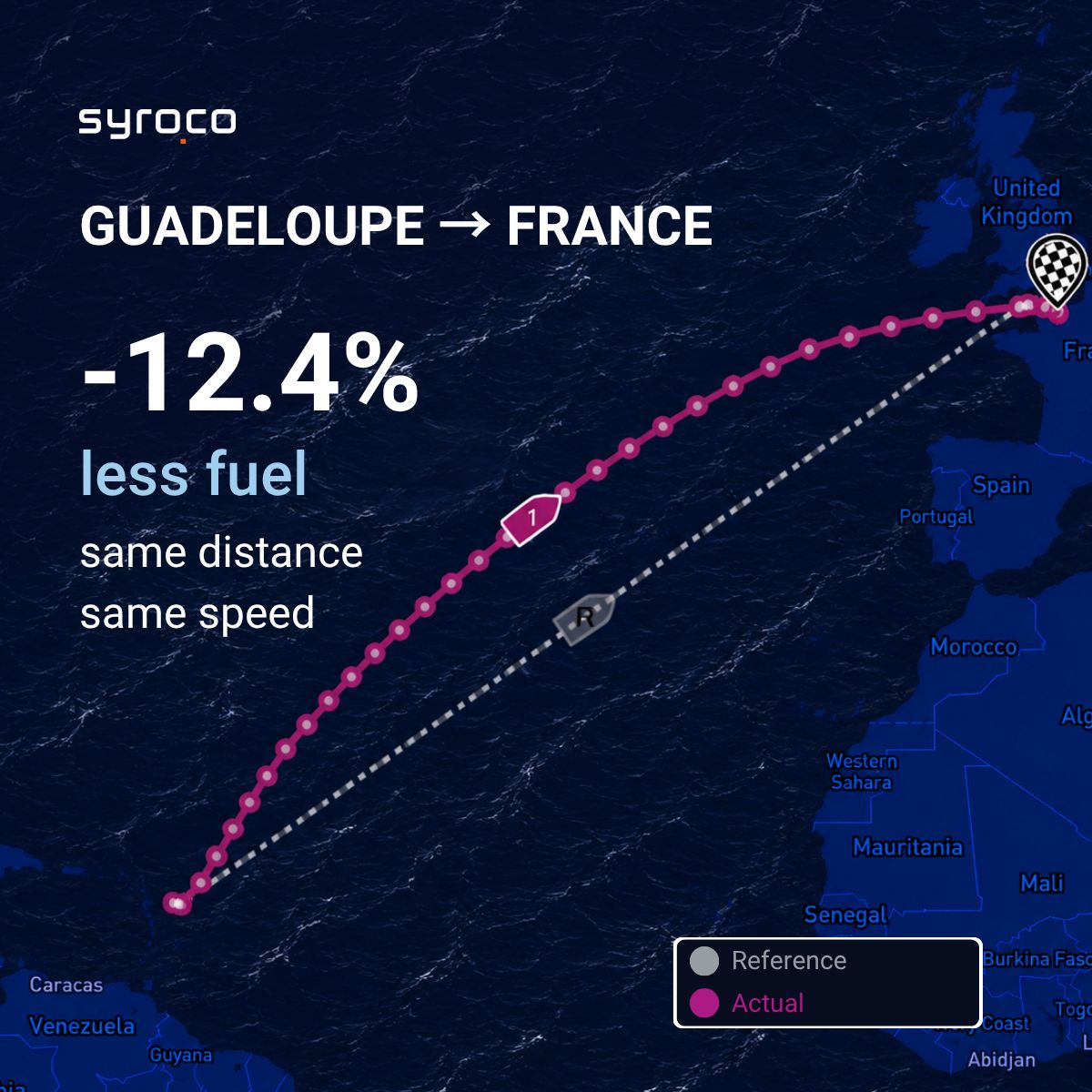
That's why Syroco Live doesn't calculate one "best" route. Before every calculation runs, it adapts to what the voyage actually needs, through one of three objectives: Best Time, JITA (Just In Time Arrival) and Best TCE (Time Charter Equivalent). Underneath all three, the engine is the same: a digital twin of the vessel, recalibrated against live and forecast weather. It always works to minimise fuel, no matter which objective you pick.
Which Objective for Which Need
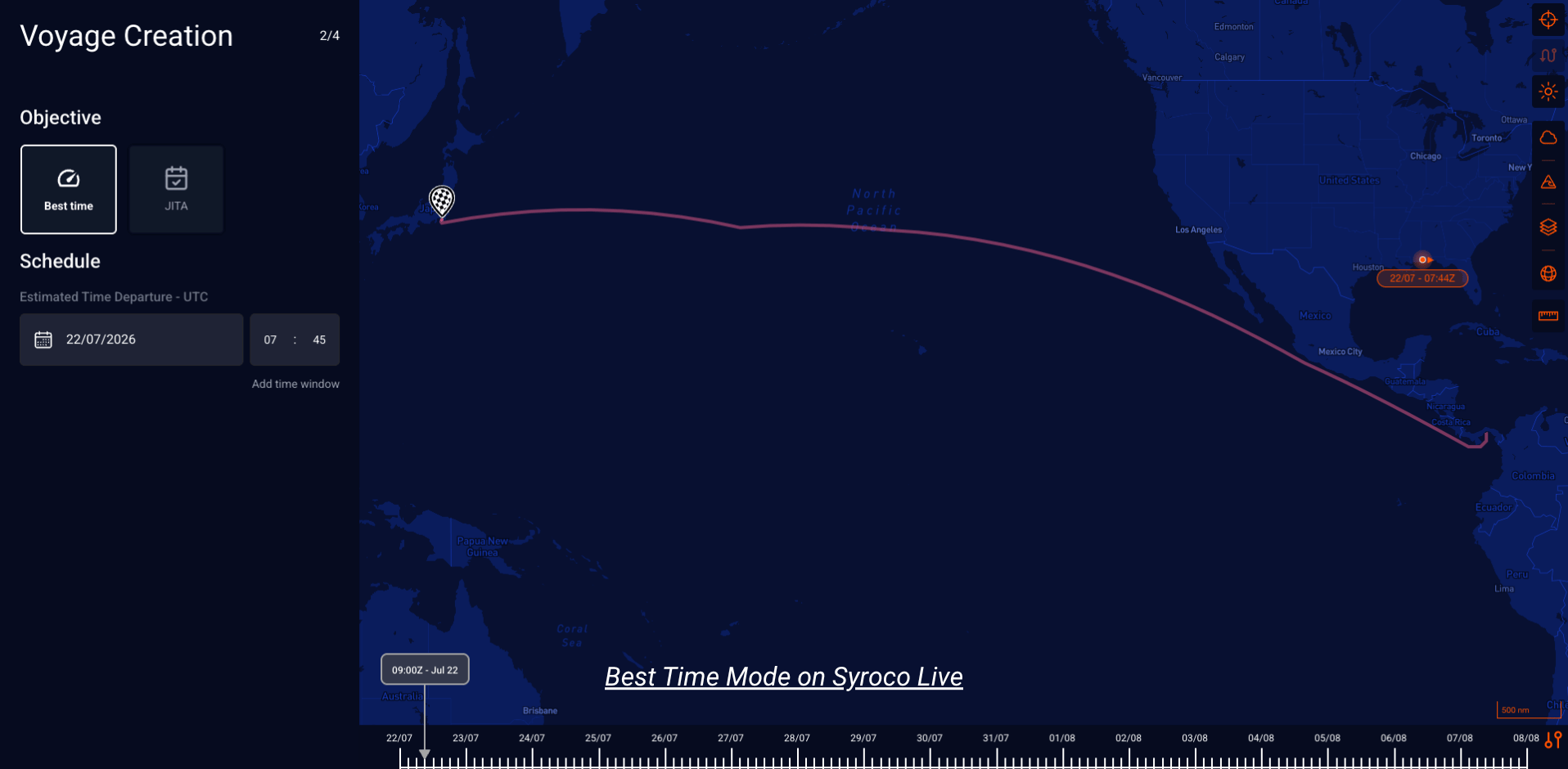
Best Time. Full speed, fuel spent to buy time - the earliest possible arrival, weather permitting. The value here isn't the arrival itself; it's what happens after. A vessel freed up sooner is a vessel available sooner for its next fixture. More rotations across a year is more margin, and Best Time is the objective built to buy that time back.
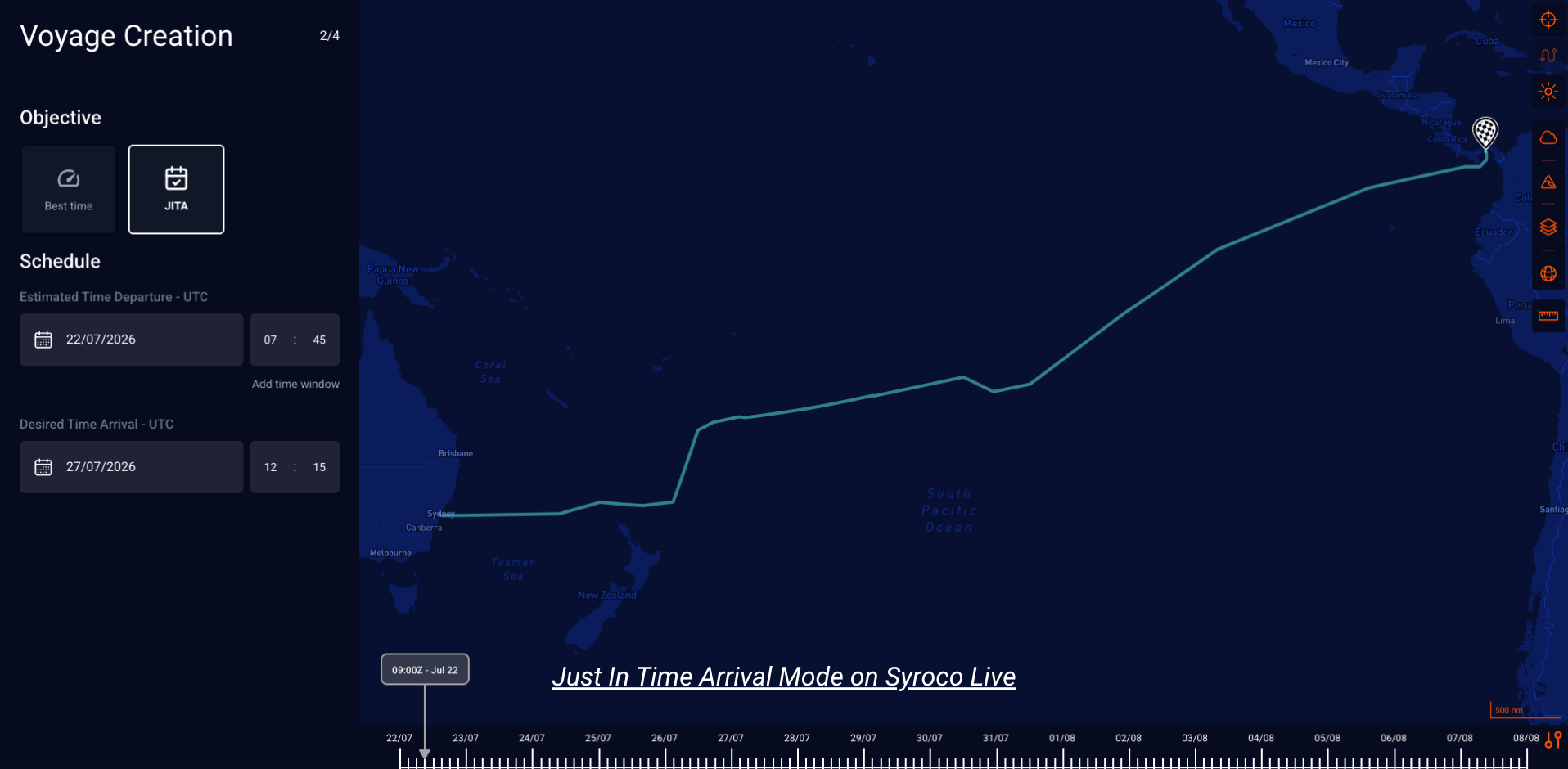
 JITA - Just In Time Arrival. The name borrows from Just In Time, a logistics principle familiar well beyond shipping. JITA applies it to a single variable: arrival time, matched to within 15 minutes of what's desired, not early, not late. That precision isn't cosmetic. Arriving early at a port slot, a lock, or a tidal window that isn't open yet doesn't save anything; it means burning fuel to sit at anchor and wait. Fuel burned for nothing is money burned for nothing. JITA exists to make sure that trade never has to happen.
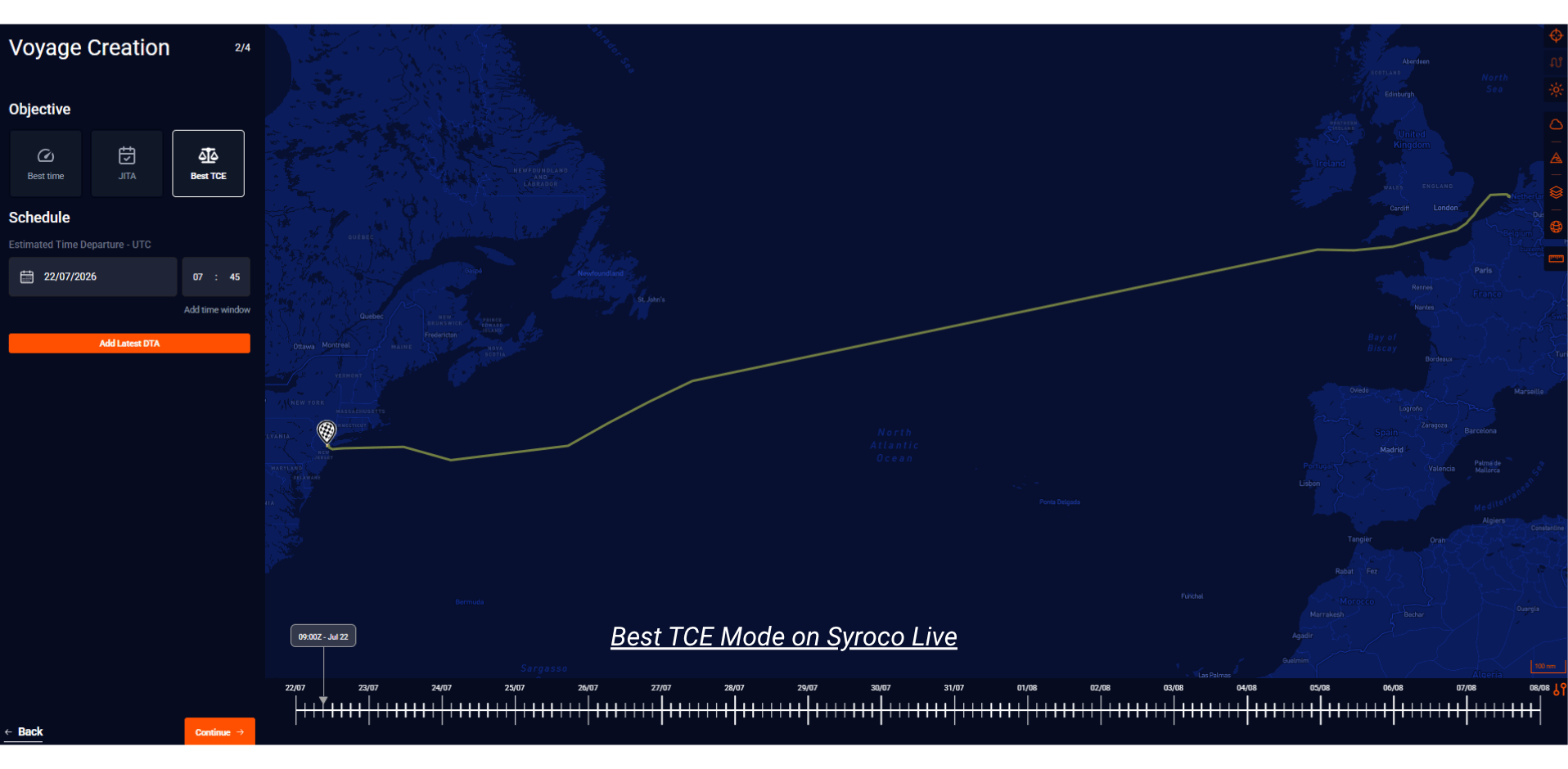
 Best TCE - Time Charter Equivalent. Neither speed nor timing - just more margin. TCE is the industry's standard measure of what a voyage actually earns per day: voyage revenue minus voyage costs, divided by voyage duration. Fuel is only one side of that equation; the other is the vessel's daily hiring rate, which runs regardless of speed. Best TCE weighs the two against each other and finds the ETA that maximises the return, not the ETA that spends the least.
Why Best TCE Isn't Automatically the Best Choice
It's tempting to assume the margin-optimised mode always wins. It doesn't, and the reason is structural, not situational.
Best TCE finds the genuinely optimal ETA only when nothing external is forcing the schedule. The moment a fixed constraint exists - a booked port slot, a tidal window, a charter-party arrival clause - its logic stops working in your favour.
Here's why. Best TCE doesn't know or care that a slot exists; its only job is to balance fuel against the daily hiring rate. Faced with a fixed slot, it might still find that easing off speed slightly saves fuel and improves the daily return, a gain of a few dollars a day. But if that slower speed pushes the arrival past the slot, the vessel doesn't just arrive a bit late: it waits for the next opening, which might be days away. Every one of those days is still billed at the full daily hiring rate, with no cargo moving, and possibly demurrage charges on top, depending on the charter terms. A few dollars a day saved in fuel is nothing next to that.
That's why, when a real deadline exists, JITA protects the voyage's economics better than the mode explicitly built to optimise them, not by counting cost, but by making sure the deadline that dominates the cost is never missed.
One Question Decides It
- A fixed deadline you don't control - a tide, a slot, a charter clause → JITA.
- No fixed deadline, but the vessel is needed for its next fixture → Best Time.
- No deadline, no rush → Best TCE.
Syroco Live puts that choice on screen before the first calculation runs. When the answer isn't obvious from the chart alone, OnWatch - Syroco's 24/7 support team - works through it with the captain, operators and shore team. The decision stays on the bridge.